
Inside Ecopeace’s CES 2024 & 2026 Recognition Journey
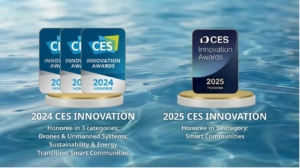
In January 2024, amid the global spotlight of CES in Las Vegas, Ecopeace achieved a major milestone. Its AI ECO-ROBOT received not one but three CES Innovation Awards, recognized in Drones & Unmanned Systems, Sustainability & Energy Transition, and Smart Communities. A year later, Ecopeace returned with its next-generation Healing Boat, earning another CES Innovation Award in the Smart City category.
These recognitions were more than moments of celebration. They were strong signals that Ecopeace’s vision for autonomous, AI-powered water management is gaining global validation.
Why CES Recognition Matters
For cities, utilities, and government agencies, adopting new environmental technologies is never a simple decision. Public sector innovation often moves carefully, shaped by budget constraints, procurement complexity, and the need to minimize risk.
That is why CES recognition matters.
The CES Innovation Awards are judged by experts in engineering, design, and technology, providing third-party validation that a product is not just conceptually innovative, but also functional and credible. For public agencies evaluating new approaches to freshwater management, this kind of recognition helps build trust and reduce uncertainty.
In other words, CES recognition does not just raise visibility. It strengthens confidence.
What Ecopeace was Recognized For
Ecopeace’s award-winning technologies reflect a broader shift in water management: moving from reactive cleanup to proactive, intelligent operation.
ECO-BOT: Autonomous Monitoring and Remediation
The AI ECO-ROBOT, commercially deployed as ECO-BOT, was recognized for combining autonomous navigation, real-time sensing, and chemical-free pollutant removal in a single platform.
Rather than relying on manual patrols and reactive cleanups, ECO-BOT helps operators continuously monitor water conditions while physically removing algae and surface pollutants. It is designed to work as part of an integrated ecosystem that connects robotics, sensing, data analysis, prediction, and reporting.
This creates a closed operational loop:
Monitor → Analyze → Predict → Act → Report
That integrated model is one of Ecopeace’s key differentiators. It is not simply a robot, and not just a monitoring tool. It is part of a broader water intelligence platform designed for more responsive and sustainable management of lakes, reservoirs, canals, and urban waterways.
Healing Boat: Water Infrastructure Meets Public Experience
If ECO-BOT represents operational innovation, the Healing Boat represents a new vision for public water infrastructure.
Recognized at CES for its Smart City value, the Healing Boat combines environmental function with public engagement. It is designed not only to help purify water, but also to create new possibilities for eco-tourism, recreation, and environmental education.
This is where Ecopeace’s thinking becomes especially distinctive. Instead of treating water infrastructure as something hidden in the background, the Healing Boat reimagines it as a visible, community-friendly asset.
A Shift Toward Predictive Water Management
At the heart of Ecopeace’s technology is a simple but powerful idea: water management should not begin only after pollution becomes visible.
Traditional approaches are often reactive. A bloom appears, debris accumulates, complaints rise, and then action begins. Ecopeace’s platform is designed to change that. By combining real-time sensing, AI analysis, and autonomous operation, it supports earlier detection, better decision-making, and more timely intervention.
For cities and utilities, this means a more proactive operational model—one that can improve efficiency, reduce labor intensity, and better protect water quality.
Why This Matters for the Public Sector
The significance of Ecopeace’s CES journey goes beyond awards. It reflects growing recognition that freshwater management needs new tools.
Public agencies today are under increasing pressure to:
- improve environmental quality,
- reduce labor and operating costs,
- meet sustainability targets,
- and respond more effectively to climate-related water challenges.
Ecopeace’s solutions align closely with these priorities by offering:
- Cleaner and safer water environments
through autonomous, chemical-free pollutant removal - Greater operational efficiency
through reduced manual intervention and continuous monitoring - Stronger sustainability performance
through renewable energy integration and ecosystem-friendly treatment approaches
These are not abstract benefits. They address the real-world needs of the agencies and operators responsible for managing freshwater bodies under growing environmental pressure.
Looking Ahead
Ecopeace’s recognition at CES 2024 and 2025 marks an important chapter in its growth, but not the end of the story.
The company continues to expand its integrated water intelligence platform, develop new applications, and work with global partners to bring autonomous and predictive water management into real-world environments.
As cities around the world rethink how they manage water quality, Ecopeace believes the future will be defined by systems that are autonomous, data-driven, and sustainable.
The journey from CES to global deployment is still unfolding—but one thing is already clear: the future of water management is no longer just about cleanup. It is about intelligence, prevention, and long-term resilience.
About Ecopeace
Ecopeace delivers AI-powered water intelligence for next-generation freshwater management. By combining autonomous robots and predictive analytics, we help cities move from reactive water operations to proactive, sustainable management systems.
References
CES Innovation Awards. (2024). AI ECO-ROBOT – ECOPEACE (2024 Honoree). https://www.ces.tech/ces-innovation-awards/2024/ai-eco-robot/
CES Innovation Awards. (2026). AI ECO-ROBOT – ECOPEACE (2026 Honoree).
https://www.ces.tech/ces-innovation-awards/2026/healing-boat/

