
A Guide to Real-Time Data and Digital Twins

When a Lake Becomes a Liability
The High Cost of Reactive Water Management
“Is the lake in your city an asset—or a liability?”
Ask a park director, utility manager, or smart city planner, and you’ll often get the same reaction: a sigh before an answer. A lake that once lifted a city’s image and livability can quickly become a source of odor complaints, algae headlines, and recurring clean-up costs. Sometimes it happens overnight—clear water one day, a green surface bloom the next—and the place that should have been a public amenity becomes a public-health worry and a reputational crisis.
The real problem is not just aesthetics. Harmful algal blooms can disrupt ecosystems, threaten wildlife, and raise public anxiety about safety and water stewardship. Yet many agencies still rely on a fundamentally reactive playbook: periodic sampling, lab turnaround times, and action only after the visible signs appear. By the time results come back, the “golden time” for prevention is often gone. Emergency responses—chemical treatments, manual cleanups, closures, and public notices—are expensive, disruptive, and hard to repeat every season.
This is why the question needs to change. Not “How do we respond faster?” but “How do we manage water bodies as continuously as we manage other critical city infrastructure?” The answer points toward a new paradigm: data-informed, operationally repeatable water management—supported by real-time monitoring, field robotics, and digital decision tools.
Why the Old Model Breaks
Why Now is the Moment for Intelligent Water Systems
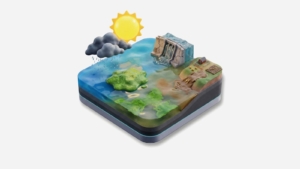
Climate stress, urban runoff, and nutrient loading increasingly create the conditions for frequent blooms. As these risks become more dynamic, occasional snapshots are no longer enough. Water managers need visibility that is closer to “always-on” than “once in a while,” and they need the ability to translate that visibility into consistent operations.
That’s where digital water management systems come in—not as a single magic switch, but as a practical shift in how agencies see, decide, and act.
Ecopeace: Operating Water Quality with Robots and Data
Ecopeace frames freshwater management as an operational challenge—not only a monitoring problem. Its solution set is built around field-ready robotic platforms, a data environment for analysis and visualization, and continuous filtration technology designed for long-term operation. Rather than describing everything as one fixed “integrated architecture” by default, the website presents these as complementary solution areas—Robots, Data, and Filtration—that together support more proactive, efficient management.
Seeing the Water: Real-Time Visibility and Decision Support
Ecopeace’s data solution focuses on integrating and analyzing field-collected data so operators can track trends, analyze algae outbreaks, and validate operational performance on a unified platform.
It also explicitly positions Water Intelligence as an approach that begins with multi-layer data collection and evolves toward digital twin–based prediction and simulation, emphasizing a roadmap-like direction rather than overstating today’s capabilities.
On the dashboard, Ecopeace highlights practical operator tools: real-time CCTV, minute-level updates of key water-quality indicators, and map-based visualization such as robot tracking alongside cyanobacteria density heatmaps—features intended to improve situational awareness and support faster, more informed decisions.
Moving in the Field: Robotic Platforms for Cleanup and Monitoring
On the robotics side, Ecopeace positions its solutions as designed for real-world water challenges—debris removal, water-quality monitoring, and data collection/analysis—aimed at stable operation across diverse environments.
ECOBOT is described as an autonomous water robot that cleans surface water while collecting water data under real-world conditions. It targets tasks such as algae and floating pollutant removal, surface cleaning, and water-quality monitoring across lakes, rivers, and reservoirs—helping operators manage water environments more effectively through repeatable field operations.
Healing Boat is presented as a purification platform designed for touristic environments, using core stacks like filtration and renewable energy (including solar panels) to support stable, continuous outdoor operation, with quiet, low-impact autonomous navigation that fits recreational settings.
ECO-Station is introduced as a fixed system designed for large-area purification and long-term operation, integrating filtration and monitoring components into a stable site-based solution for sustained management over time.
Importantly, these descriptions keep the focus on field operations and operational outcomes—what the solutions are designed to do—rather than making aggressive, hard-to-verify promises about universal autonomy levels or guaranteed forecasts.
Stabilizing the System: Continuous Filtration for Long-Term Operation
For environments requiring sustained treatment, Ecopeace introduces its Continuous Filtration System as an uninterrupted approach designed to maintain stable water conditions through continuous filtration.
The page emphasizes removing suspended solids, sediments, and algae with automated control that adapts to inflow variation, a clog-resistant design, and features such as mesh-filter–based filtration, continuous real-time backwashing, and a sludge recycling process that includes collection and dewatering/post-processing for resource recovery. \
What This Changes for Cities
With this approach, water quality management becomes less like crisis response and more like ongoing infrastructure operations: field platforms handle repeatable tasks, digital tools provide a single operational view, and continuous filtration supports stability where long-term treatment is required. The goal is straightforward: reduce blind spots, reduce manual load, and improve the consistency of water management across seasons and events—without relying on chemical-heavy stopgaps as the first option.
About Ecopeace
Ecopeace delivers AI-powered water intelligence for next-generation freshwater management. By combining autonomous robots and predictive analytics, we help cities move from reactive water operations to proactive, sustainable management systems.
