
The Future of Water Management:

Growing Pressure on Freshwater Management
Water management organizations around the world are facing increasingly challenging situations. This is because they are simultaneously required to keep freshwater environments clean and safe amid climate change, aging infrastructure, and limited budgets and staffing. Water pollution from algal blooms, floating debris, and similar factors is no longer a rare occurrence, but a recurring one, increasing both environmental burdens and public concern.
Yet many organizations still rely on regular water sampling or reactive cleanup efforts. This approach struggles to keep up with the rapid pace of change in water environments and has limitations in recognizing problems early. Against this backdrop, there is growing interest in tools that enable more continuous observation and faster judgment, while complementing and scaling incrementally with existing operations.
Why traditional approaches are under strain
Climate change is making water quality management more complex.Droughts increase pollutant concentrations and raise water temperatures, increasing the likelihood of algal blooms, while heavy rainfall introduces large amounts of nutrients and debris into lakes and reservoirs.Water infrastructure designed decades ago often did not account for this level of variability, leading to rising operational costs and increasing management burdens.
Workforce challenges are also adding to the pressure.Field-based management activities conducted along shorelines or on open water are labor-intensive and involve safety risks.Amid an aging skilled workforce and labor shortages, agencies are under pressure to maintain regulatory compliance and public trust with limited resource
How AI may support earlier insight
AI-based technologies are gaining attention not as replacements for traditional water management, but as tools that complement existing approaches.By continuously analyzing water quality data such as temperature, turbidity, dissolved oxygen, and chlorophyll-a, AI systems can learn baseline conditions for individual water bodies and detect subtle signals of change.
When combined with historical data and weather information, this analysis can help estimate the likelihood of issues such as algal blooms before they occur. Furthermore, the use of digital twin concepts allows agencies to evaluate potential responses in virtual environments and assess whether they should be applied in the real world. This presents an opportunity to complement decision-making processes that have traditionally relied on experience and intuition in a more systematic way.
The role of robotics in physical action
While AI focuses on analysis and prediction, robotics addresses physical intervention. Autonomous surface robots are being tested as a way to patrol lakes, reservoirs, and canals, collect localized data, and remove floating debris or surface pollution using chemical-free methods.
These systems are not intended to replace existing infrastructure or field personnel, but to support repetitive tasks in large or hard-to-access areas. This can help reduce safety risks for field workers and enable more consistent management.
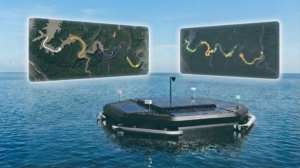
An integrated, pilot-driven approach
Ecopeace is applying an integrated framework in real-world settings that connects monitoring, analysis, and action through autonomous robots (ECOBOT) and an AI platform.
Monitor → Analyze → Predict → Act → Report
Current projects focus on validating this framework in real-world environments. Rather than pursuing immediate large-scale deployment, this approach emphasizes pilot phases to evaluate performance, operations, and site suitability before gradual expansion.
This approach is designed to help partner organizations make informed decisions about next steps based on sufficient evidence.
Looking ahead: potential roles of technology
Integrated AI and robotic systems can help detect water quality risks earlier, reduce reliance on emergency responses, and contribute to safety and sustainability goals.
Of course, these technologies are not a universal solution to every challenge.
However, as climate change increases uncertainty in water environments, these tools are likely to play an increasingly important role by enabling continuous observation and data-driven decision-making.
Ecopeace continues to work with public agencies, utilities, and research partners to explore how these approaches can be applied to specific local water environments.
