
How HEALING-BOAT Expands a New Model for Public Freshwater Management

Urban lakes, reservoirs, park ponds, and waterfront spaces are not just water assets. They are public spaces tied to recreation, ecology, city image, and local tourism.
That is why water quality problems tend to have effects far beyond environmental management. When blooms, floating debris, odor, or discoloration appear, public agencies are not only dealing with water treatment concerns. They are also dealing with citizen complaints, declining use of public spaces, pressure on park and tourism operations, and broader questions about how public waterfronts are being managed.
In many places, these pressures are growing. Climate change and changing urban conditions are making water quality deterioration more frequent and less predictable. This has made freshwater management more difficult for many cities, especially in highly visible public spaces where environmental quality and user experience are closely connected.
In this context, HEALING-BOAT suggests a different approach. It is not simply a water purification device. It is a model that combines water quality improvement and waterfront use within a single public infrastructure concept.
A new model for public waterfront management
Conventional public water quality management has often separated management functions from public use.
Purification systems and treatment equipment typically belong to back-end operations. Public use areas—such as park lakes, recreational waterfronts, and tourism-oriented water spaces—are managed separately. As a result, even when water quality management is essential, it can still appear to citizens as a cost-heavy maintenance function rather than something that directly improves public service.
HEALING-BOAT changes that structure.
It combines water purification with public-facing use. Because its environmental function can be linked with citizen experience, environmental education, and waterfront programming, water management infrastructure becomes easier to connect to visible public value.
For public agencies, this distinction matters. It means that investment in water quality can also support broader goals such as better public communication, stronger use of waterfront spaces, and more visible delivery of environmental policy.
What is HEALING-BOAT?
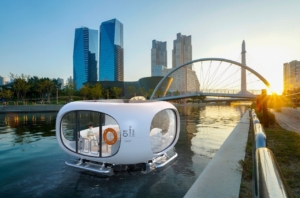
HEALING-BOAT is an AI-powered, solar-based autonomous vessel designed to combine water purification with public use.
It can purify up to 100 Tons of water per day using chemical-free physical filtration methods suited to freshwater environments. At the same time, it can accommodate up to eight passengers, making it suitable for eco-tours, environmental education, water experience programs, and small community activities.
It can also provide real-time environmental information through onboard digital displays, including water quality data and ecological content.
In other words, HEALING-BOAT is both a purification platform and a public waterfront service platform.
Why this is different from conventional approaches
The difference is not only technical. It is also operational and policy-related.
Traditional purification infrastructure is usually evaluated mainly through operational efficiency. HEALING-BOAT adds another layer: public experience.
Because purification happens in a visible, citizen-facing way, it becomes easier for agencies to explain why environmental investment matters and what practical benefits it creates. Instead of remaining an invisible back-end function, water quality management becomes something people can directly see, understand, and in some cases even participate in.
This makes HEALING-BOAT especially relevant in places where water quality, public use, and city image work together.
Public value for cities and agencies
Making water management more visible
Environmental management is essential, but it is not always easy for citizens to recognize. Budgets are spent, but the work often remains invisible until something goes wrong.
HEALING-BOAT helps reduce that gap. Because the purification function is visible on the water itself, agencies can communicate environmental management in a more tangible way. This can make it easier to explain both the need for water quality management and the value of continued investment.
Expanding the value of waterfront spaces
A waterfront space needs to be more than clean. It also needs to be a place where people want to spend time.
When water quality declines, the value of park lakes, recreational reservoirs, and tourism-oriented waterfronts can drop quickly. When water quality is maintained more consistently, those same spaces can become stronger civic, tourism, and ecological assets.
Because HEALING-BOAT can connect purification with education, guided interpretation, and public programming, it offers a way to think about environmental infrastructure not only as a management tool, but also as part of broader place activation.
Supporting clearer policy communication
Public projects are not judged only by performance. They are also judged by whether their purpose and benefits can be clearly explained.
HEALING-BOAT has an advantage here. Because purification and citizen-facing use are combined, the policy message is easier to communicate. The conversation does not need to stay at the level of “improving water quality” alone. It can also be framed as improving the quality of public waterfront spaces that citizens use and value.
Where this model may be relevant
HEALING-BOAT may be especially worth considering in waterfront locations where public visibility and symbolic value are high, such as:
- urban park lakes
- tourism-oriented reservoirs
- canal waterfronts
- ecological park water bodies
- mixed-use waterfront developments
In these settings, water quality, landscape value, user experience, and city identity often influence one another. That is where a model combining purification and public use may have stronger practical value.
Strategic significance
If conventional purification systems are mainly operational infrastructure, HEALING-BOAT can be understood as infrastructure that also supports public engagement and city identity.
During the day, it can connect with ecological learning, environmental interpretation, and water experience programs. In other settings, it may support community-oriented waterfront content or public-facing programming. This gives cities more flexibility in how environmental infrastructure is positioned and used.
That is also why the model matters from a city branding perspective. For local governments pursuing smart city, ecological city, or climate-resilient city agendas, HEALING-BOAT can function not just as equipment, but as a visible example of how environmental challenges are being addressed in practice.
This broader significance has already been recognized internationally. HEALING-BOAT received a CES 2025 Innovation Award in the Smart City category, drawing attention as a model that connects environmental technology with citizen-facing public infrastructure.
How agencies might begin evaluating it
For public agencies, the key question is rarely whether a technology is impressive. It is whether the technology can realistically be introduced and operated in the local context.
In that sense, HEALING-BOAT can be approached not as a display concept, but as a practical option for spaces where water quality management and waterfront programming may need to be considered together.
Early evaluation can begin with a few basic questions:
- Is this a waterfront space with high citizen visibility or symbolic importance?
- Does water quality deterioration occur repeatedly?
- Is there value in connecting environmental management with place activation?
- Are there opportunities to link the site with education, tourism, or park programming?
If the answer to several of these questions is yes, then HEALING-BOAT may be worth considering not simply as equipment, but as part of a broader waterfront management strategy.
Conclusion
Public freshwater management is no longer only about water quality. It increasingly sits at the intersection of citizen experience, urban identity, environmental policy, and spatial value.
That is why future waterfront management may require more than adding treatment equipment alone. In some places, it may become increasingly important to consider approaches that can both improve water quality and create visible public value.
HEALING-BOAT suggests one possible direction. By combining purification with public use, and by turning environmental management into something citizens can more easily experience and understand, it expands how public agencies can think about freshwater infrastructure.
Not every waterfront space will need the same model. But in locations where environmental quality and public experience are closely linked, HEALING-BOAT may offer a meaningful new option worth exploring.
About Ecopeace
Ecopeace delivers AI-powered water intelligence for next-generation freshwater management. By combining autonomous robots and predictive analytics, we help cities move from reactive water operations to proactive, sustainable management systems.

